
Madonna, Forever
On "Confessions II," the pop superstar turns her recent experiments in looking back into another masterful reinvention.

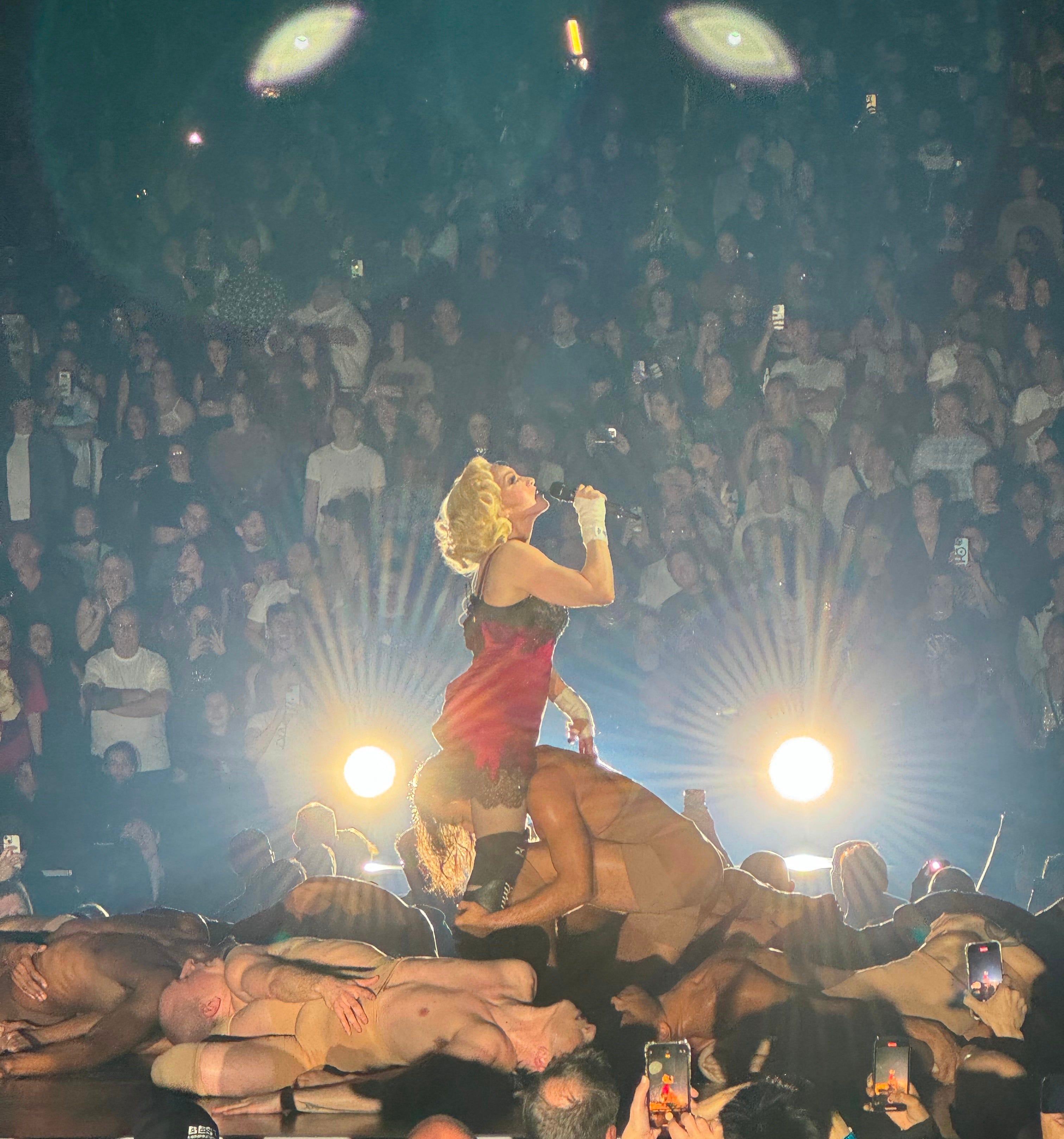
On the surface, it seemed like an obvious conceit: a live retrospective by one of music’s biggest names. But it wasn’t quite that straightforward. Madonna was at a crossroads, and her Celebration Tour was far more than a pop spectacle.
The superstar’s distaste for looking back was so profound, her 1990 greatest hits album, “The Immaculate Collection,” is best known for its two brand-new songs, “Justify My Love” and “Rescue Me.” In concert over four decades, she presented beloved tracks as remixes or rethinks — turning “Like a Virgin” into a German cabaret number; mashing up hits like “Vogue” and “4 Minutes” (or “Don’t Tell Me” and “Bittersweet Symphony”); remodeling “Material Girl” with a stuttering beat while slowing its perky riff into a smear; cranking “I Love New York” into a chugging electric-guitar barn burner.
Madonna’s motivations were clear: She didn’t want to get bored; she needed to stay inspired; her restlessness was a feature, not a bug. Her second compilation, “GHV2,” contained only songs that “have listening power for me,” she said in a 2001 BBC interview when it was released. “I had to be able to listen to them, like five times in a row and think ‘This is really good.’”
Another notable tidbit came from that Radio 1 conversation with Jo Whiley: “I might work with this guy that I met when I was looking for some musicians to play with. His name is Stuart Price,” she said. “We started fooling around with remixes and redoing a lot of the tracks for the actual live show and we talked about working on stuff for my next album.”
Price, who had previously made electronic music in several guises (including Les Rythmes Digitales), played some keyboards on 2003’s “American Life” and co-wrote its finger-picked meditation “X-Static Process,” but their fully realized collaboration arrived two years later in a very different idiom: “Confessions on a Dance Floor,” a 56-minute throb that stitched the brain-tickling wooziness and body-moving thump of club music to pop song structures.
“Confessions” is a fresh and thrilling album that redirected conversation about Madonna’s career yet again — she had made a conceptual opus about desire and ambition that nodded to the past while rocketing toward the future. And its lead single, “Hung Up,” embodied the power of transformation, flipping a keyboard twirl from ABBA’s “Gimme! Gimme! Gimme! (a Man After Midnight)” into its driving motif.
Price was a staple of Madonna’s live shows from her return to touring in 2001 after an eight-year pause through the Confessions Tour in 2006, and the pair reunited for the Celebration Tour in 2023. The show came at a fraught time for the Queen of Pop: Her spotty 2019 album, “Madame X,” debuted at No. 1 aided by ticket and merch bundling but swiftly fell off the Billboard 200; her tour supporting it — with experimental, cabaret-style staging heavy on Portuguese influence that ran as short theater residencies — showed flashes of brilliance but did not win over many fans. The run aggravated a long-suffering knee and she underwent surgery. As Covid spread, her social media veered questionable. She labored on a script for her own biopic and warred with the film studio. And as always, the kids were coming up from behind.
Then the tour’s start was stalled by a medical emergency: a bacterial infection so severe, Madonna later revealed, she was unconscious in the ICU for several days and soon bedridden with debilitating sepsis. Against this dramatic and emotionally charged backdrop, she undertook the challenge she had long avoided: a grand experiment in revisiting her past onstage. Through song choices, set design, partially improvised speeches, costumes, choreography, appearances by her children, videos, and photographs, Madonna told her tale — one shaped by losing and becoming a mother, and carving out an uncharted creative life.
The Celebration Tour was a successful trial. “Confessions II,” the album Madonna released earlier this month, is the masterpiece. (It is also a milestone: Her 10th No. 1 album.)
In a musical landscape where the past is a payday and acts routinely repackage, reissue, and hope for rediscovery on TikTok, Madonna has once again set the bar, employing nostalgia not as a cash machine or a wistful window into yesteryear but as ripe raw material. An artistic tool. An incitation to revel in the present and dare to project an ecstatic future. She has, simply put, reinvented it.
“Confessions II,” a second full-scale partnership with Price (with contributions from a short list including Arca, Cirkut, Tainy, Andrew Watt and Mirwais), is a sequel in spirit, but ultimately a very different project. Embedded in its seemingly frothy reverie is scholarship — not about the (largely Black) history of dance music, like Beyoncé’s brilliant “Renaissance,” but Madonna’s own influence. Madonna, a month from 68, hasn’t made an album in conversation with contemporary pop in a while, and that hasn’t changed; this is her first in conversation with her own legacy.
The LP is stocked with allusions — to previous titles, lyrics, chords, synths, syncopations, and themes as well as juicy backstories. (It’s no wonder fans are gravitating to the joyful “Danceteria,” not only for its irresistible “Everybody get up and dance” chorus but its roll call of notable early ’80s New Yorkers.) On the Celebration Tour, Madonna fondly conjured this time when punks, rappers and DJs, new wavers, avant-gardists, and at least one extremely ambitious pop songwriter cross-pollinated.
Madonna has long sung about dancing as freedom, but in an era where political leaders and digital devices are redefining reality, the directive is more urgent: on “I Feel So Free” (with its enveloping, womblike pulse), the sweepy and insistent “One Step Away,” and “Love Without Words,” built on a curious synth twinkle. The marginalized have long found a haven in dance music — “Safety in numbers” — and Madonna repeatedly welcomes the listener to come in and find community.
As a nexus of reflection, “Confessions II” strikes Madonna’s other significant touchpoints, too: religion as metaphor (“My Sins Are My Savior” featuring Stromae), her enduring appreciation for Latin music (“Read My Lips” with Feid), her distaste for those who challenge her (both of those).
Likewise, there’s a glorious track about a doomed love (“Bizarre,” with Martin Garrix), a bit of spiritual guidance that could have been plucked from “Ray of Light” (“Good for the Soul,” which dips into ‘90s-style electronica), and a reminder of her cultural and sexual dominance (the exceptional grind of “School”).
The last quarter of the LP ventures away from its overarching sonic vision, returning to the looser beats and airier production of “Erotica” and “Bedtime Stories” for a few remarkably personal pieces. “Fragile” is a farewell to her brother Christopher, a close collaborator who drifted and published a stinging tell-all memoir (the two made peace before his 2024 death). “The Test” is a reconciliation with Madonna’s eldest daughter, credited as Lola Leon, who sings of the push and pull of their unusual lives with a soulful lilt.
The writer and producer Mirwais joined for “Betrayal,” about Madonna’s complex relationship with her stepmother (who also died in 2024), with a stunning track that combines a trip-hop beat, a jazzy trumpet figure, and an interpolation of “Gnossiennes: No. 1” by the 19th century proto-Minimalist French composer Erik Satie. And the closer “L.E.S. Girl” steps into a different aesthetic entirely, as Madonna gives grace to herself as a youthful seeker against a gentle guitar pattern that winks at Nico’s version of “These Days.”
Even as it lands on that dreamy note, “Confessions II” crackles with vitality. It’s a battle cry for lived experience, to create and prioritize tactile memories. Madonna’s trips back to the past and personal reckonings didn’t reveal an icon ready to rest on her laurels, but ignited a desire to exist in the moment — to sweat and scream alongside humans in person.
That’s what she’s been doing at Club Confessions, the handful of late-night events she and Price have thrown to promote the LP. Around 1 a.m. in Queens on Sunday morning, Madonna stepped out as a track of her voice repeatedly intoned “It’s mother,” presiding over a multigenerational crowd dripping in perspiration and anticipation. The star, a famous perfectionist known for crisp choreography, is dancing in a new way at these parties: unrehearsed, unselfconscious, even a little unhinged. She sang a few bars. She struck a few poses. She looked so free.
Hi, all: Thanks for coming.
I am still plotting OnlyGanz, but couldn’t resist writing about one of my favorite subjects. Stick with me, there will be more ...
For more me on Madonna, please see:
My 2023 review of the Celebration Tour — I was a little iffy about what I had written on deadline at 4 a.m. but now I am convinced it was right on target (and nearly everything applies to the new album)
60 Times Madonna Changed Our Culture — a herculean cross-desk effort at The New York Times I shepherded to mark her 60th birthday
Bandsplain: Madonna, Part 4 — three hours and 41 minutes of conversation with Yasi Salek about all of the albums from “Confessions” through “Madame X”
For more takes on “Confessions II”:
I have to admit I haven’t consumed anything yet because I didn’t want other opinions to color my experience with the album, but I can safely recommend Shaad D’Souza at Pitchfork, Rob Sheffield at Rolling Stone, Craig Jenkins at Vulture and Ira Madison at Frank (and not only because I know he shouted out my 2008 “Hard Candy” review in there!). And my fellow Madonnasplainer Mel Ottenberg interviewed the artist herself for the latest cover of Interview.
Everyone here is a work of art

I don’t know if this is a “lost art” per se, or I just don’t come across writing like this that often anymore but thank you for this transfixing cultural critique and deep dive. I couldn’t put it down, which is saying something in the Phone Age.
She is so singular and we are so lucky that she keeps making art - all the better that it’s good, but it’s what, her and David Byrne left being relevant from that heady time?
It’s like a dream.
We may never get this biopic, but it definitely spawned the self-reflection and self-mythologizing that’s all over this inspired album. How exciting to have an urgent Madonna musical moment again.